
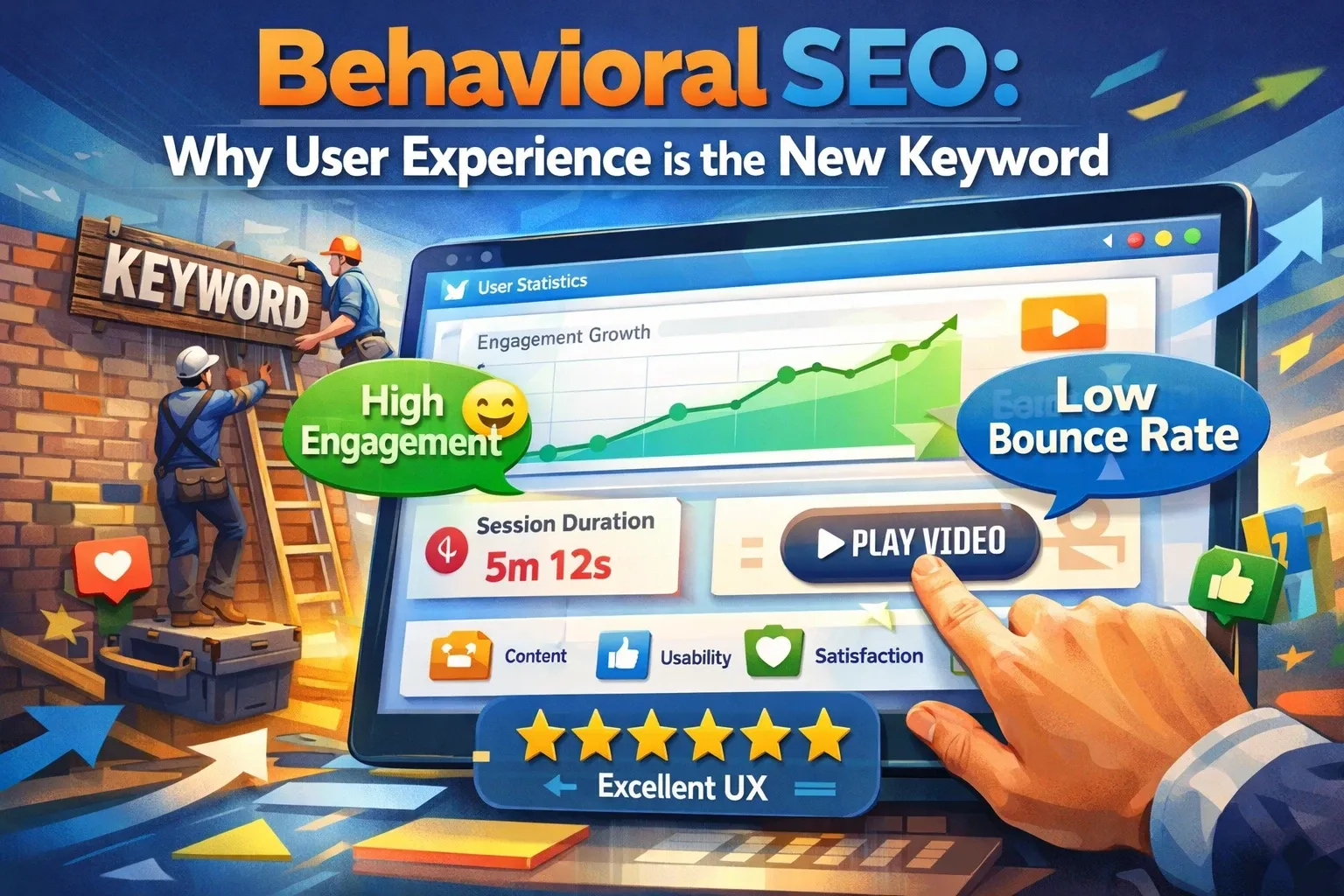
Behavioral SEO: Why User Experience (UX) Is the New Keyword
Honest question: Do you still think Google reads your articles?
Let me let you in on a little secret I learned the hard way: Google hasn't been a "reader" for years. Today, Google is a "watcher." It doesn't care nearly as much about how many times you repeat "best cleaning service" in your text as it does about what a visitor does when they land on your page.
This is what we call Behavioral SEO. And it’s the exact reason why websites with mediocre grammar often outrank "perfect" content that sits on page two.
It’s Not About "What" You Write, It’s About "How" It’s Consumed
Back in the day, the formula was simple: Find a keyword, stuff it in the h1 tag, repeat it five times, and hello page one. But today's AI algorithms (like RankBrain and BERT) understand user sentiment.
Yes, their feelings.
Was the user satisfied? Or frustrated? Did they find the answer instantly, or did they have to scroll for three miles to get to the point? Every tiny click, every pause to read a paragraph, is a coded message sent straight to Google saying: "This site is worth keeping."
Metrics You Can't See, But Google Can
Let's go deeper. You might hear tech terms thrown around, but let me translate them into real behavioral language:
1. Pogo-sticking (The Bounce Back)
This is enemy number one. Imagine someone searches for "how to make pizza," clicks your site, and leaves in under 5 seconds to click the next result. To Google, that’s not just a visit. That’s an insult. It tells the algorithm your result was useless, and you'll be demoted faster than you can blink.
2. Rage Clicks
Ever clicked a "Download" button that didn't work? So you clicked it five times in anger? The browser records that. "Violent" or random interaction means your UX is broken. And broken sites don't rank in 2026.
Want to Improve Your Website Performance?
Get a free comprehensive analysis of your site speed and SEO performance in seconds
3. Scroll Depth
Clients tell me all the time: "My article is 3,000 words!" Great, but did anyone see the end of it? If 90% of visitors stop after the first 500 words, then to a search engine, your article is effectively 500 words long. The rest is just filler.
Personal Take:
I honestly believe the term "Search Engine Optimization" should be renamed to "User Experience Optimization." If you focus your energy on making the human happy, comfortable, and informed, the algorithm will naturally reward you. Robots follow humans, not the other way around.
How to Apply Behavioral SEO Today?
You don't need a psychology degree, just apply these simple tricks:
- The 3-Second Hook: Stop with the boring, fluffy intros ("In today's modern world..."). Get to the point immediately. Make the visitor feel they are in the right place before they blink.
- Break the Wall of Text: Nobody likes reading endless blocks of text. Use bullet points, images, and quotes to give the reader's eyes a break.
- Answer First, Elaborate Later: Give the quick answer at the top (for the skimmers), then explain the details below (for the deep divers).
The Bottom Line
The new keyword isn't a word you type, it's an experience you create. In the AI era, good content is content that gets read, shared, and lived. Stop writing for algorithms, and start writing for the humans who use them.
Now, go check your last article... would YOU read it to the end?



No comments yet. Be the first to comment!