
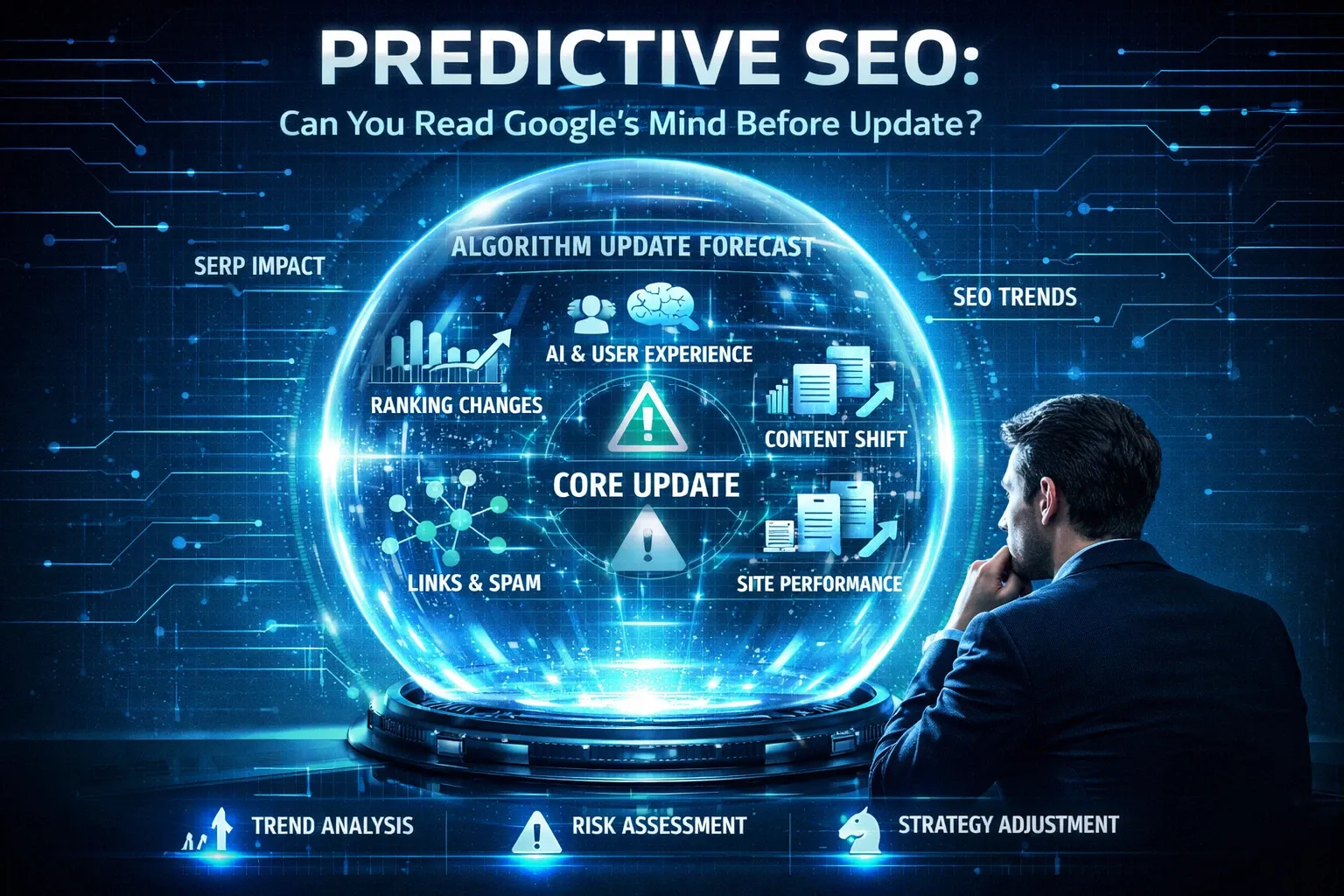
Predictive SEO: How to Use AI to "Sense" Disaster Before It Hits?
Have you ever felt that sinking feeling in your stomach one morning, when you open your dashboard only to find your traffic has plummeted by 60% overnight?
It’s the "Core Update." The ghost that terrifying every website owner.
For the last ten years, we’ve been playing "firefighters." Google starts a fire with a new update, and we run around with extinguishers trying to save what’s left. But, what if I told you there’s a way to know the fire is coming two weeks before the first spark?
Welcome to the era of "Predictive SEO."
We Don't Use Crystal Balls.. We Read Patterns
It’s not magic or sorcery. Google, no matter how smart, is ultimately a "machine." And machines follow patterns. Before any major update, Google runs thousands of small tests. These tests leave "digital footprints" and volatility that can be tracked.
Predictive SEO is simply using big data tools to spot these tiny "tremors" and understand the general direction before it becomes a tsunami.
How to Apply This Magic Practically?
I’m not asking you to be a data scientist, but here is how I use data to protect my clients' sites before everyone else:
1. Watch the "Canary in the Mine"
In old coal mines, workers carried a canary. If the bird died, they knew toxic gas was present and ran. In the SEO world, the "Canary" is the highly sensitive niches like YMYL (Your Money Your Life - Health & Finance).
Want to Improve Your Website Performance?
Get a free comprehensive analysis of your site speed and SEO performance in seconds
Expert Tip:
Monitor volatility in medical and legal websites. Google updates often start by "testing" new standards there. If you see an earthquake hitting medical sites, prepare yourself... your tech or news site is next in line.
2. Analyze the "New Losers"
Instead of looking at who ranks first, look at who has recently disappeared. If you notice Google suddenly punishing sites that use "Clickbait Titles" in the tourism sector, that's not a coincidence.
This means the algorithm learned a "new pattern" of spam. Your predictive task here is to audit your site immediately: Do I have similar titles? Change them tonight, before the update reaches you tomorrow morning.
3. Follow the Money (Use Experience Trends)
Google is a for-profit company. Its goal is to keep users happy to show more ads. The next trend is always "what annoys users today."
- Are people complaining about AI-generated content? (Predict a penalty for automated content).
- Do people hate intrusive pop-ups? (Predict a Page Experience update).
The Takeaway
In 2026, survival is for the smartest, not the strongest. Don't wait for Google to tell you your site is bad by destroying your traffic. Be proactive. Read the data, sense the danger, and adjust your sails before the storm hits. The difference between an amateur and a pro is that the amateur asks "What happened?", and the pro says "I saw that coming."



No comments yet. Be the first to comment!